So your doctor has recommended a gastroscopy. Naturally, you probably want to know what you’re actually signing up for.
Do you have to fast? Will you be awake? Can they take a sample if they see something unusual? And once it’s finished, are you free to get on with your day?
Those are the sorts of questions patients ask all the time.
A gastroscopy, sometimes called an oesophageal-gastroduodenoscopy (OGD), uses a thin flexible camera to examine the oesophagus, stomach and duodenum. It can be used to investigate symptoms including ongoing heartburn, trouble swallowing, abdominal pain, vomiting and unexplained weight loss.
There is a bit more to the appointment than the few minutes of the actual examination, so it’s worth knowing what happens around it too.
Before the Gastroscopy
A little bit of the work happens before you even arrive.
You’ll usually be asked to fast for a certain period beforehand so the doctor can examine the upper digestive tract properly. How long you need to fast can vary, though, so this is one of those times when your clinic’s instructions matter. Typically, fasting of solid food, at least 6 hours before the procedure is required. Don’t go by something you read online or what your neighbour did for their gastroscopy.
Medication is another thing to sort out.
Tell your doctor what you’re taking, even if it seems unrelated. That includes prescription medicines, supplements and blood thinners. Some medications need special planning, but that doesn’t mean you should stop them yourself. Your doctor will tell you whether anything needs to change.
It is also worth speaking up about allergies, previous sedation problems and any medical conditions you have. Better to mention them before the gastroscopy rather than after.
What Happens During a Gastroscopy?
This is probably the part people are most curious about.
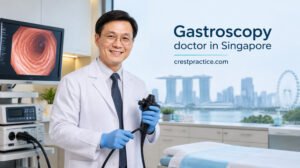
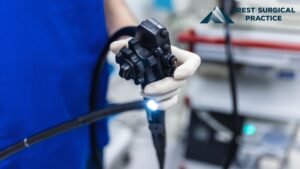
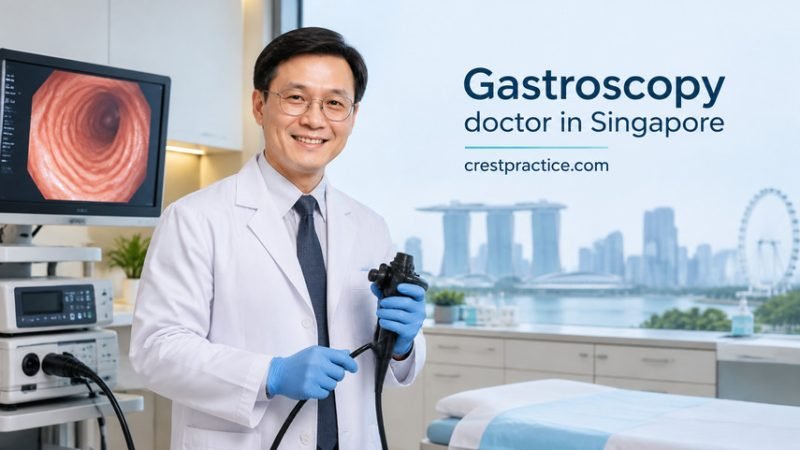
You’ll be asked to lie on your side while the doctor carefully guides the gastroscope through your mouth and into the upper digestive tract. The camera lets the doctor look at the oesophagus, stomach and duodenum on a screen.
There is no surgical cut involved.
Crest Surgical Practice explains that throat anaesthetic and sedation may be used, depending on the situation, to make things easier to tolerate. You will be completely asleep during the procedure with sedation. The examination usually takes around 15 to 30 minutes. Your appointment will be longer than that because you’ll need some time before and after the procedure.
Sometimes biopsy can be taken during the gastroscopy. You generally won’t feel this. The tissue is then sent for laboratory examination so it can be looked at more closely.
What Happens Afterwards?
This is where the appointment isn’t quite finished yet.
After the procedure, you’ll usually spend some time recovering, particularly if sedation was used. A sore throat or some bloating can occur for a short time after gastroscopy and generally self resolved quickily. Crest advises avoiding strenuous activity for the rest of the day.
If you have been sedated, make sure you follow the clinic’s instructions about getting home and about driving or other activities that require full alertness.
Your doctor may be able to discuss the initial findings with you after the gastroscopy. That doesn’t necessarily mean every answer will be available immediately. If biopsies were taken, the tissue needs to be processed and examined, and the results may take a few days. Follow-up is then arranged as appropriate.
What Should You Ask Your Doctor?
Before leaving the clinic or booking the procedure, it is reasonable to ask:
How long do I need to fast?
Should I change any of my medicines?
Will sedation be used?
Do I need someone to accompany me home?
When and how will I receive biopsy results?
A good Gastroscopy doctor in Singapore should be able to explain what is planned for your particular situation, rather than giving you a generic answer that may not apply.
Crest Surgical Practice provides gastroscopy and other endoscopy services in Singapore, with specialist surgeons experienced in gastrointestinal conditions and endoscopic procedures.
A gastroscopy may only take a short time to perform, but the whole experience includes preparation, recovery and follow-up. Once you know what those parts involve, the appointment tends to feel a lot more manageable.